
Cafe Scientifique – My Part in Discovering The Gluon!
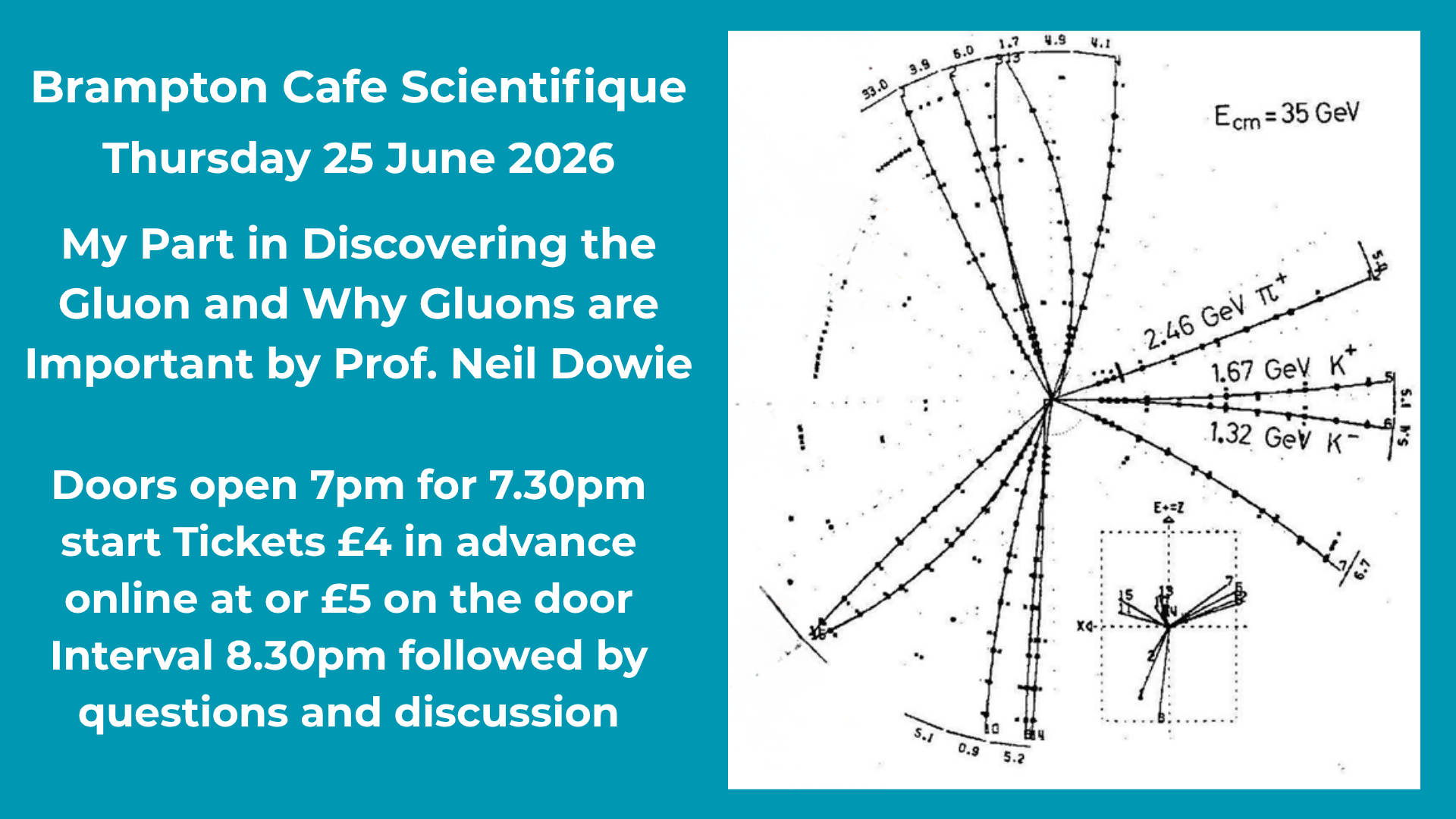
My Part in Discovering The Gluon!
Synopsis:
- What made me right for a career in particle physics – school, hobbies, universities – at an international accelerator
- What a Gluon is and making/running article detectors inside TASSO* the 1000-ton machine at DESY**, the German CERN in the late 70s
- Running TASSO and analysing the data, using the latest computers, electronics and a kind of Internet – the first in the world!
- Hamburg and the TASSO team – and having fun with Scottish music and dancing in Hamburg
- Discovering things in High Energy Positron-Electron Collisions and…
- Discovering the Unexpected: the Gluon
* The TASSO (Two Arm Spectrometer SOlenoid) was a massive particle detector used at the PETRA** electron-positron collider at the DESY*** laboratory in Hamburg, Germany. Operating between 1978 and 1986, it was historically famous for providing the first direct evidence for the three-jet events produced by gluons
** The PETRA (Positron-Elektron-Tandem-Ring-Anlage) accelerator is a massive particle storage ring located at the DESY laboratory in Hamburg, Germany [1, 2]. Originally a groundbreaking collider, it revolutionized high-energy physics in the late 1970s and 1980s before transforming into the world’s brightest X-ray source.
*** DESY Deutsches Elecktronen-Synchrotron is one of the world’s leading centres for research on and with particle accelerators
Biography.
Neil hugely enjoyed his part in finding the particle which glues together the quarks from which we are all made, as well as the delights of working in a team of super bright people. And he also had lots of fun in 1970s Hamburg, even helping colleagues like Tim Berners-Lee develop the Internet. He started in junior school doing lots of science and being known as ‘The Prof ‘. He made all sorts of things from model autogyros to steam-powered fairground models at home, he went to a super school and spent 3 years in the 6th Form doing tons of stuff, not just A levels from Maths to Geology but also building his own science projects. He went to Merton College, Oxford, to read physics. There he did lots of practical physics, had super summer jobs in research labs, and even blasted targets with a proton beam accelerator as a student project.
From Oxford, he went to Imperial College, Rutherford Lab, and then Hamburg, working on the DESY Accelerator where he was part of the team that discovered the gluon. His career was in R&D, covering electronics and semiconductors but mainly industrial gases like oxygen, helium, xenon etc with British Oxygen (now Linde) and Air Products (American version of BOC). He did lots of work with schools ( and still does) and ran a Saturday Science class for junior school children most weeks for years. He wrote the 4 Saturday Science books full of ingenious new inventions you can make yourself, demonstrating science and engineering for everyone. He also wrote a standard textbook on Industrial gases and filed over 30 international patents for his employers!
Tickets from £4 booked in advance or £5 on the door. Book online here